
Blackland Prairie Soil Foundation Repair:A Complete Guide
North Texas Blackland Prairie clay expands, contracts, and destroys foundations year after year. Urban Concrete & Construction brings licensed expertise and rapid mobilization to Dallas-area homes and commercial properties facing structural failure.
- Learn more about polyurethane slab stabilization Dallas TX in Arlington
- Learn more about multi-family underpinning Dallas
- Learn more about post-tension cable repair Dallas in Garland
- Learn more about PTI certified post-tension repair Dallas in Irving
- Learn more about polyurethane slab stabilization Dallas TX
- Learn more about flash flood washout repair Dallas in Plano
- Learn more about deep-drilled underpinning Dallas in Fort Worth
Dallas's Blackland Prairie Is an Engineering Problem. We Solve It.
Urban Concrete & Construction is a licensed, insured foundation and concrete contractor serving the entire Dallas Metroplex. We specialize in the specific geotechnical challenges posed by Vertisol clay soils that shift with every wet and dry cycle North Texas delivers.
Our team responds to both residential emergencies and commercial structural failures. Whether a slab has settled six inches or a post-tension cable has snapped under differential pressure, we mobilize fast with the equipment and licensed expertise the job demands.
We operate 24 hours a day, 7 days a week, because foundation problems in Dallas do not respect business hours. A Friday-night crack in a load-bearing wall can become a Saturday-morning structural collapse if it is not assessed immediately.
Structural failures happen at any hour. We answer and mobilize around the clock across Dallas.
Every pour meets or exceeds 4,000 PSI compressive strength specifications suited to North Texas conditions.
We serve residential and commercial clients across the full Dallas-Fort Worth service area.
Why Blackland Prairie Soil Is Uniquely Dangerous to Foundations
The Blackland Prairie stretches across North Texas, and the clay soil beneath Dallas is classified as a Vertisol. Vertisol soils have an unusually high shrink-swell capacity. During dry periods, the clay contracts, pulling away from foundation edges and creating voids beneath slabs. When rain returns, the clay expands with tremendous pressure, pushing upward and laterally against anything in its path.
This cycle does not just happen once. It repeats with every drought and rain event throughout the year. Over five to fifteen years, the cumulative differential movement beneath a slab produces cracking, settling, tilting, and, in severe cases, structural failure. Dallas's flash-flooding patterns compound the problem by delivering sudden soil saturation to already-stressed foundations.
The USDA Natural Resources Conservation Service classifies Vertisols as having the highest shrink-swell potential of any major soil order. That classification has direct structural consequences for every slab, pier, and retaining wall built on Dallas ground.
Warning Signs You Cannot Ignore
Diagonal cracks from door corners
Doors and windows sticking or jamming
Visible floor slope or bouncing
Gaps between walls and ceiling
Cracked or bowed interior walls
Stair-step cracks in brick veneer
Visible foundation separation
Settling or tilting retaining walls
Pooling water near the foundation
Cracks in slab-level concrete
If you identify more than one of these signs simultaneously, the problem is likely active and accelerating. Early-stage intervention is far less costly than structural restoration after a slab has shifted three or more inches. Do not wait for the next inspection cycle.
Need emergency assessment now? Our emergency foundation repair team in Dallas is available 24/7 and can be on-site same day.
Repair Methods Matched to North Texas Conditions
Generic repair methods fail on Blackland Prairie soil. Every technique we deploy is selected for Dallas's specific geotechnical environment.
Foundation Underpinning
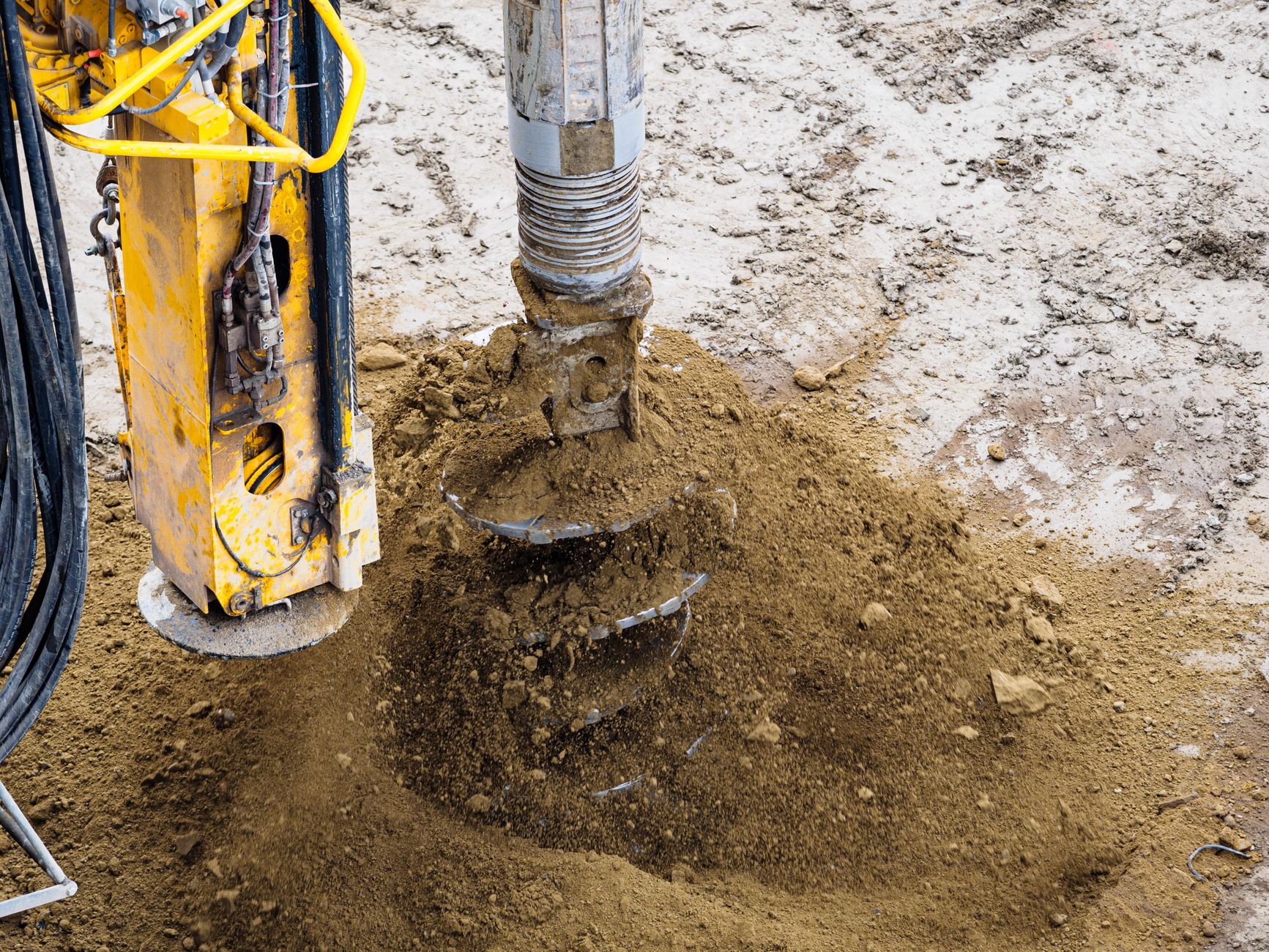
Deep-drilled pier underpinning transfers structural load past the active clay zone to stable, non-expansive strata below. We drill to refusal depth, typically reaching bedrock or competent soil at 15 to 25 feet depending on site conditions, then install steel piers that provide a fixed, reliable bearing point.
Helical piers and pressed-concrete piers are also deployed based on the load requirement and soil profile determined from site evaluation.
Post-Tension Cable Repair
Post-tensioned slab systems are common in Dallas residential construction, and a failed cable is a structural emergency. When a cable snaps or slips its anchor, the tensile force that was holding the slab together is lost in that zone, inviting rapid cracking and settling.
Our technicians locate, expose, repair, and re-stress post-tension cables using PTI-standard practices. For more on this risk, see our emergency post-tension cable repair page.
Polyurethane Void Filling
When Blackland Prairie clay contracts and pulls away from a slab, voids form beneath the concrete, causing settlement and point-loading failures. Polyurethane foam injection is injected through small-diameter ports drilled at strategic intervals, expanding to fill voids and re-establish uniform support.
This method is minimally invasive, cures within minutes, and allows the structure to return to service the same day in most cases.
Commercial Slab Repair & Industrial Coatings
Warehouse floors, commercial parking decks, and distribution center slabs demand a different standard than residential work. We repair commercial concrete using 4,000 PSI mixes, saw-cut joint systems, and industrial polyurea coatings that resist chemical exposure, abrasion, and hydrostatic pressure beneath the slab.
ADA compliance is built into every commercial slab repair we perform, including grade transitions, cross-slope tolerances, and surface texture requirements. For a detailed commercial scope overview, visit our commercial concrete slab repair page.
Retaining Wall Repair & Stabilization
Lateral earth pressure from saturated Blackland Prairie clay is a primary cause of retaining wall failure in Dallas. After heavy rainfall, expansive soil exerts hydrostatic pressure against wall faces, causing tipping, cracking, and foundation scour at the toe.
We stabilize compromised retaining walls using soil nail anchors, helical tiebacks, or full reconstruction with proper drainage provisions behind the wall face. Details are covered on our emergency retaining wall repair page.
Multi-Family and Apartment Foundation Repair
Multi-family properties face compounded foundation risk because multiple load paths, common walls, and shared slab sections mean that one settling corner can produce cracking throughout an entire building wing. Property managers and HOA boards often underestimate the speed at which differential settlement progresses.
We work with apartment owners and commercial property managers across Dallas to assess, stabilize, and restore multi-family foundations with minimal unit disruption. If you're budgeting for a repair project, our guide on apartment foundation repair costs in Dallas provides real 2026 pricing context.
When Storms Hit, Foundations Pay the Price
Dallas flash floods deliver several inches of rainfall in hours, saturating soil that was bone-dry the week before. This rapid saturation dramatically accelerates the Vertisol expansion cycle, and the resulting hydrostatic pressure beneath slabs and against retaining walls can cause failures that took years to develop to complete in a single storm event.
Storm runoff that concentrates near a foundation perimeter is particularly destructive. Subterranean erosion channels form when water moves through the void spaces opened by prior clay contraction, steadily removing soil support from beneath slab edges.
After any significant weather event affecting your property, a visual inspection of foundation perimeter concrete, retaining walls, and interior door and window alignment is warranted. Do not wait for the second storm.
Foundation repair in Dallas must account for the geotechnical profile of the site, not just visible surface conditions. The ASTM International standards for soil classification and deep-foundation installation govern how we spec every repair we perform in North Texas.
We scope repairs based on the actual bearing stratum, not a generic depth assumption. This means drilling to refusal and verifying load transfer before the pier is locked off.
For active structural emergencies, we target a same-day assessment response across the Dallas Metroplex. Stabilization work begins within 24 to 48 hours of confirmation for most residential and light commercial situations.
Same-day site assessment available
Emergency stabilization within 24-48 hrs
Licensed and insured on every job
Every structural pour we complete meets or exceeds 4,000 PSI compressive strength, verified by slump testing and cylinder breaks when required by the project scope.
We specify mix designs with appropriate water-cement ratios and admixtures for Dallas's ambient temperature extremes, which range from freezing conditions in winter to 105-degree curing heat in August.
See our guide on concrete repair costs in Dallas for specification and pricing context.
PTI, ASTM, and the Engineering Standards That Protect Your Investment
"The quality of a foundation repair is invisible once work is complete. That's why the standard behind the work matters more than the finished surface."
Post-Tension Institute Standards
Post-tension slab systems require specialized knowledge that general concrete contractors often lack. The Post-Tensioning Institute (PTI) publishes standards for design, installation, and repair of bonded and unbonded post-tensioned concrete. Our technicians work to these standards on every cable repair.
A failed or improperly repaired post-tension cable does not just weaken a slab locally. It changes the entire stress distribution across the slab, potentially causing cracking well away from the original failure point.
ADA Compliance in Commercial Repairs
Settled or cracked commercial concrete can create ADA compliance violations that expose property owners to liability. Cross-slopes exceeding 2%, vertical lips above 1/2 inch, and surface roughness that impedes wheelchair travel are all code-trigger conditions.
We include ADA surface and grade compliance review on every commercial slab repair project, documenting pre- and post-repair conditions for property records.
What to Expect During a Foundation Assessment
- 1Step 1: Site Visit & Visual Survey
We walk the full perimeter and interior, documenting crack patterns, floor slopes, and any exterior grade issues contributing to drainage problems.
- 2Step 2: Depth & Load Analysis
We evaluate the structural load requirements and soil profile to determine what bearing depth will achieve long-term stability for the repair approach selected.
- 3Step 3: Repair Scope & Specification
A written scope is produced, specifying the method, materials, depths, and standards that will govern the work, including concrete PSI, pier type, and drainage provisions where needed.
- 4Step 4: Permitted Work & Final Inspection
Where required by Dallas municipal code, we pull permits and coordinate inspections. For permit and compliance questions, our Dallas concrete repair FAQ page covers common scenarios.
Your Foundation Cannot Wait Until Monday.
Blackland Prairie clay does not stop moving because it is after hours. Cracks that appear overnight can widen significantly by morning if the active soil movement driving them is not addressed. Urban Concrete & Construction operates 24/7 and can dispatch to your location across the Dallas Metroplex the same day you call.
We are licensed and insured in the state of Texas. Every assessment is performed by experienced structural repair technicians, not a sales team. When you call, you get answers, not a pitch.
Every technician and subcontractor on your project operates under our active Texas contractor license and general liability insurance.
Active structural emergencies receive priority dispatch. We assess the situation the same day you call, not during the next available appointment slot.
We serve residential and commercial clients throughout Dallas County, Tarrant County, Collin County, and surrounding areas of the DFW Metroplex.
More Resources from Urban Concrete & Construction
Explore our guides and service pages to understand your specific situation.
Real pricing data and scope breakdowns for multi-family foundation work.
Read guide → Multi-Family & Commercial Foundation RepairHow we handle complex commercial foundation scopes across Dallas.
Learn more → Concrete Sidewalk Repair Cost in Dallas (2026)What sidewalk and flatwork repair actually costs, and what drives the price.
Read guide → Dallas Concrete Repair FAQPermits, timelines, specifications, and common questions answered.
View FAQs →