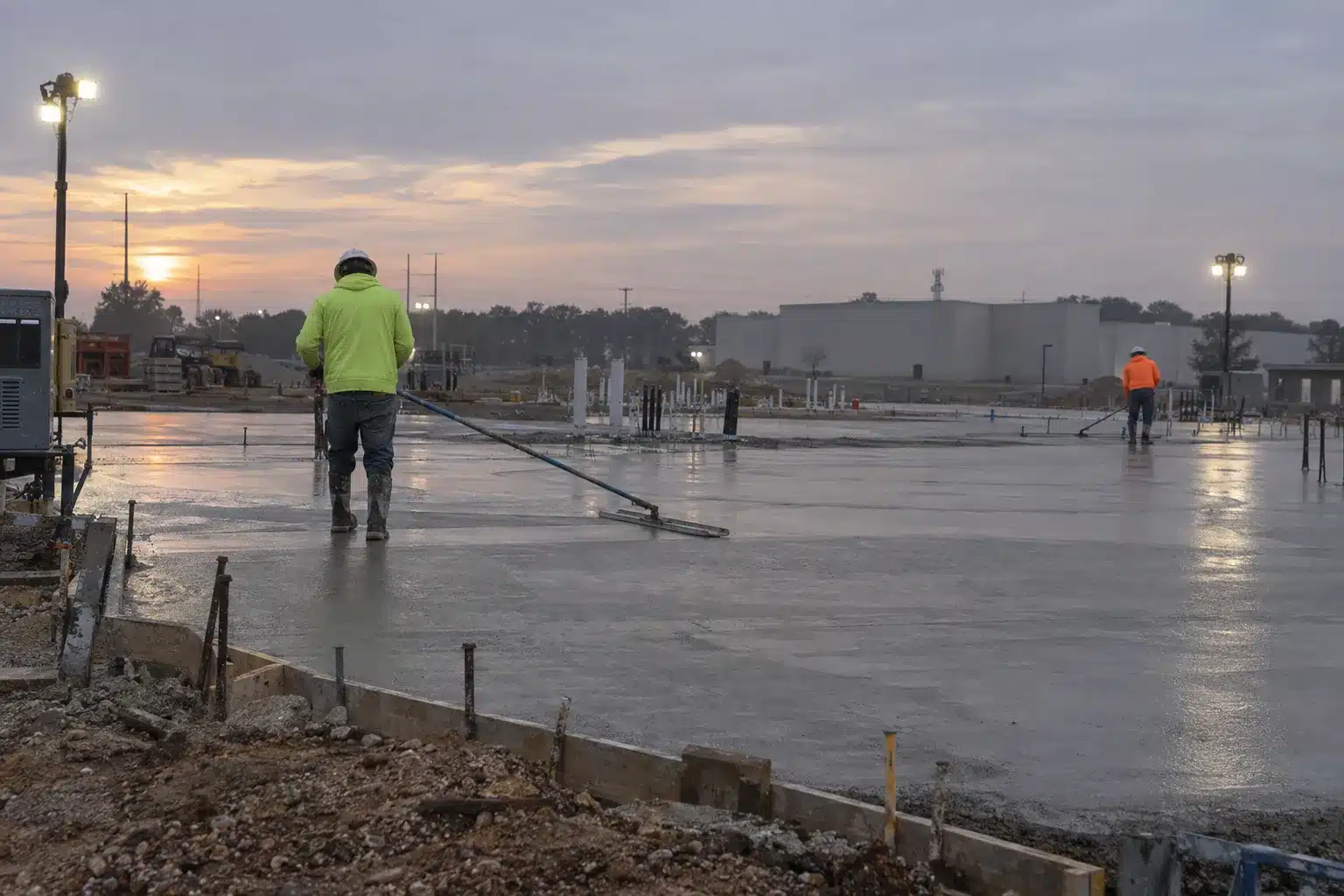
How Long Does Commercial Concrete Slab Installation Dallas Take?
What Dallas commercial property owners and project managers need to know about realistic timelines for commercial concrete slab installation - from site prep through final cure, permit realities, and what actually causes delays.
Blackland Prairie expansive clay soil adds complexity to every phase of a commercial slab pour in Dallas. Subbase prep takes longer, moisture conditioning is non-negotiable, and skipping either step costs you the slab. Know the real schedule before you commit a contractor.
Why Dallas Slab Timelines Are Longer Than You Expect
Commercial concrete slab installation in Dallas does not run on the same clock as a residential pour. A warehouse slab, retail pad, or industrial floor involves engineered subbase preparation, City of Dallas permit processing, concrete placement coordination, post-tension or rebar scheduling, and a mandatory cure window before any structure can be built on top. The actual concrete pour is often the shortest phase of the entire job.
The core problem in Dallas is Blackland Prairie Vertisol clay. This soil shrinks during drought and expands with rain, generating vertical movement that can destroy a commercial slab poured over an improperly conditioned subbase. The City of Dallas Paving Design Manual addresses this directly - subgrade moisture conditioning to a target plasticity index range is a documented requirement, not a contractor option. Doing it correctly takes time. Skipping it costs you the slab.
Diagram showing the sequenced phases of commercial concrete slab installation: site clearing, subgrade conditioning, base course compaction, form setting, reinforcement placement, concrete pour, and cure period.
For a commercial slab of 5,000 to 20,000 square feet in the Dallas metro, total time from initial site work to a slab ready for structural loading typically runs 3 to 8 weeks. Large industrial slabs over 50,000 square feet can run 10 to 16 weeks when you account for permit processing, subbase work, and phased pours. Anyone quoting you a full commercial slab in under two weeks is cutting the subbase preparation short.
If your existing slab has already failed due to clay movement or poor subbase prep, that is a separate but related problem. Urgent commercial concrete slab repair in Dallas handles active structural failures, but understanding why the original slab failed is essential before any repair or replacement pour.
What Separates a Compliant Dallas Commercial Slab Timeline from a Rushed One
Subgrade moisture conditioning on Blackland Prairie clay requires bringing the soil to within 2 to 4 percentage points of optimum moisture content, then verifying with nuclear density testing. This alone takes 3 to 10 days depending on current soil conditions.
City of Dallas permit processing for commercial slabs under the Dallas Development Code typically runs 10 to 20 business days for straightforward submittals. Complex industrial sites or projects in zoning overlay districts take longer.
Post-tension cable installation, required on most engineered Dallas commercial slabs over expansive clay, adds a layout and inspection phase before concrete can be placed.
Concrete cure time is non-negotiable. The slab must reach minimum compressive strength - typically 75% of design strength, or about 3,000 PSI for a 4,000 PSI design mix - before post-tension stressing or structural loading. That takes a minimum of 7 days under favorable conditions and 14 to 28 days for full design strength.
Weather windows in Dallas matter. Pouring in ambient temperatures above 95°F without a hydration management plan produces slabs that crack at the surface before the interior sets. Summer pours require early morning scheduling and curing compound application immediately after finishing.
Reference: Concrete Curing and Soil Engineering Standards
The American Concrete Institute publishes cure time and strength development guidance at concrete.org. The U.S. Army Corps of Engineers Unified Facilities Criteria for concrete flatwork provides subgrade preparation standards referenced by Dallas commercial project engineers at wbdg.org.
2026 Timeline Breakdown
Phase-by-Phase Timeline Breakdown
These durations reflect real commercial concrete slab installation projects in the Dallas metro. Each phase is sequential - you cannot compress the schedule by overlapping phases that require inspection sign-off before the next phase begins.
Most Common Scope
Mid-Size Commercial Slab: 5,000 to 20,000 Square Feet
4 to 8 weeks total
This is the most common commercial concrete slab installation Dallas scope - a warehouse addition, retail pad, or light industrial floor. Permit processing runs 2 to 4 weeks concurrently with early site work. Subgrade demolition (if replacing existing pavement), earthwork, and clay conditioning run 5 to 10 days. Crushed limestone base placement and compaction testing add 2 to 3 days. Forming, rebar or post-tension layout, and pre-pour inspection add another 3 to 5 days. The pour itself is typically one to two days for this square footage. Then the slab cures for a minimum of 7 days before post-tension stressing and at least 28 days before full structural loading.
Smaller Scope
Commercial Slab Under 5,000 Square Feet
3 to 5 weeks total
Small commercial pads - equipment slabs, dock extensions, standalone storage building floors - move faster through site prep but still require the same permit and inspection sequence. Subgrade work runs 3 to 5 days on a clean site with good moisture conditions. Permit processing dominates the schedule at this scope. The pour finishes in a single day. Cure time is the same regardless of slab size: 7 days minimum before post-tension stress, 28 days for full design-strength loading.
Larger Scope
Industrial Slab Over 50,000 Square Feet
10 to 16 weeks total
Large industrial slabs in Dallas require phased pours with construction joints engineered into the slab plan. Each phase has its own form set, inspection, and cure window before adjacent phases can be poured. Subgrade conditioning at this scale can run 3 to 4 weeks on Blackland Prairie clay. Post-tension layout and cable stressing schedules are coordinated with the structural engineer of record. This scope always involves a geotechnical report, a structural engineer, and City of Dallas plan review before a single shovel of dirt moves.
Repair or Replacement Scope
Existing Slab Removal and Replacement
4 to 10 weeks total
Replacing a failed commercial slab adds a demolition phase - saw-cutting, breaking, and hauling existing concrete - before any new subbase work begins. On Dallas clay, this also means re-evaluating why the original slab failed before pouring again over the same subgrade. If moisture infiltration or differential settlement caused the failure, the subgrade needs remediation, not just replacement base rock. Skipping that step produces the same failure on the same schedule.
Four factors account for most commercial concrete slab installation Dallas schedule overruns - and all four are predictable if you know what to look for before the job starts.
01
Subgrade Moisture Conditions at the Time of Award
Dallas clay that has been through a dry summer can be 8 to 12 percentage points below optimum moisture content. Getting it back to the target range for compaction requires controlled wetting, tilling, and retesting over multiple days. Awarding a contract after a drought and expecting a quick start is not realistic. Conversely, sites that have been flooded need drainage and drying time before subgrade work can begin. The geotechnical condition on award day dictates the prep timeline more than any other variable.
02
City of Dallas Plan Review Backlogs
Dallas Development Services processes commercial permits in cycles, and review times are not fixed. A straightforward commercial slab may clear in 10 business days; a project requiring Stormwater Management review or fire marshal sign-off can run 25 to 35 business days. Projects in the City of Dallas floodplain overlay require additional FEMA-related review. Submitting complete, engineered drawings on the first pass is the single most effective way to avoid re-review delays. Incomplete submittals restart the clock.
03
Concrete Batch Plant Scheduling and Lead Times
Dallas-area ready-mix plants book large commercial pours in advance. A slab requiring 200 or more cubic yards of concrete needs a confirmed pour date with the batch plant 5 to 10 business days ahead. Attempting to schedule a large pour with short notice risks an inadequate number of trucks, which means stopping and starting the pour - a situation that creates cold joints if the gap exceeds the concrete's initial set time. Cold joints are structural defects in a commercial slab. Getting on the batch plant's schedule early is part of the contractor's coordination responsibility.
04
Weather Windows During Pour and Early Cure
Dallas summers require early-morning pour starts to avoid placing concrete in ambient temperatures above 90°F. When concrete is placed hot, surface evaporation outpaces bleed water rise, producing plastic shrinkage cracks before the finishers can address them. Most Dallas commercial concrete contractors move large summer pours to 5:00 to 6:00 AM starts, finishing the pour before midday. This limits scheduling flexibility in June through September. Winter pours face the opposite problem: concrete placed below 50°F gains strength slowly and may need insulated blankets to maintain the minimum curing temperature, adding cost and extending the cure window.
Permits, Inspections, and City of Dallas Requirements
Commercial concrete slab installation in Dallas requires a building permit before any ground disturbance. No permit, no legal pour - and a slab placed without a permit creates title and sale complications that outlast the concrete itself.
The City of Dallas Building Inspection division reviews commercial slab permits under the Dallas Development Code and the adopted version of the International Building Code. For slabs on grade, the submittal typically requires a geotechnical report with soil bearing capacity and plasticity index data, an engineered slab plan with reinforcement details, and a grading plan addressing site drainage. Projects within 100 feet of a waterway or in a designated floodplain require additional review by the City's Floodplain Management division.
Required inspections during the work include a subgrade inspection before base course is placed, a pre-pour inspection confirming rebar or post-tension layout and form dimensions, and a final inspection after cure. Each inspection creates a hold point - the next phase cannot proceed until the inspector signs off. Coordinating those inspections with the inspector's schedule adds time that contractors who have not worked in Dallas regularly underestimate.
Suburban municipalities in the Dallas metro each have their own inspection processes. Garland and Plano typically run faster for smaller commercial scopes. Allen and Frisco, where commercial development has been dense, sometimes experience backlogs similar to Dallas proper. Always confirm the specific jurisdiction's timeline at the pre-application meeting, not after the permit is submitted.
Single-Contractor Accountability and Why It Matters for Schedule
When subgrade prep, concrete work, post-tension installation, and forming are split across multiple subcontractors, each phase handoff becomes a potential schedule gap. One sub finishes late; the next sub's crew is already committed elsewhere; the inspector is not called; the pour slips two weeks. Using a single licensed contractor for the full scope - site work through slab completion - eliminates those vendor gaps. There is one schedule, one point of contact, and one contractor accountable to the permit holder.
Urban Concrete & Construction handles commercial concrete slab installation in Dallas as a single-contractor scope. For engineered slab specifications and project process, see the engineered commercial concrete slabs in Dallas page.
Field Reality
The Pour Is the Shortest Phase of the Job
On a 10,000 square foot commercial slab, the concrete placement and finishing typically runs 6 to 10 hours. The subbase prep, permits, and cure that surround that pour take weeks. Any contractor who quotes you a "quick" commercial slab is compressing the phases you can't see. Those are the phases that determine whether the slab holds or cracks.
Frequently Asked Questions
Direct answers to what Dallas commercial property owners and project managers ask about commercial concrete slab installation timelines.
For a mid-size commercial slab of 5,000 to 20,000 square feet in Dallas, plan on 4 to 8 weeks from initial site mobilization to a slab ready for structural loading. That window includes permit processing (which often runs concurrently with early site clearing), subgrade conditioning on Blackland Prairie clay, base course placement, forming and reinforcement layout, the pour itself, and the mandatory cure period. Smaller slabs under 5,000 square feet can run 3 to 5 weeks. Large industrial slabs over 50,000 square feet with phased pours typically run 10 to 16 weeks. The 28-day full cure requirement is fixed regardless of slab size.
Post-tensioned commercial slabs in Dallas typically require a minimum of 7 days before the cables can be stressed, based on achieving 75% of design compressive strength as confirmed by cylinder break tests. Full design strength - typically 4,000 PSI for commercial applications - is reached at 28 days under standard curing conditions. Structural steel erection, tilt-wall panel setting, and other loads that impose significant point loads on the slab generally require the 28-day break test to confirm design strength before proceeding. In hot Dallas summers, properly cured slabs can reach 75% strength faster due to accelerated hydration - but surface cracking risk also increases if the cure is not actively managed with wet burlap or curing compound.
Standard commercial slab permits through City of Dallas Development Services typically process in 10 to 20 business days for a complete, code-compliant submittal. Projects that trigger additional reviews - stormwater management, floodplain overlay, fire protection - add review cycles and can push the timeline to 25 to 35 business days or longer. An incomplete first submittal restarts the review clock. Suburban jurisdictions like Garland and Plano often run faster for smaller commercial scopes. Confirming the expected review timeline with the specific jurisdiction before your project timeline is set prevents the most common scheduling surprise in Dallas commercial concrete work.
Blackland Prairie Vertisol clay has a high plasticity index - typically 30 to 60 in the Dallas area - meaning it absorbs and releases water dramatically with seasonal changes. Before placing compacted base rock and concrete, the clay subgrade must be brought to within 2 to 4 percentage points of its optimum moisture content. That requires controlled wetting or drying, mechanical tilling to distribute moisture uniformly, and nuclear density gauge testing to confirm compliance. After a dry Texas summer, this conditioning process can take 7 to 10 days on a large site. The City of Dallas Paving Design Manual addresses subgrade moisture treatment requirements directly. Skipping this step is the most common cause of premature commercial slab failure in North Texas.
Yes, significantly - in both summer and winter. Summer pours in Dallas require early morning start times, typically 5:00 to 6:00 AM, to finish placement before ambient temperatures exceed 90°F and surface evaporation causes plastic shrinkage cracking. This limits how many trucks can be sequenced in a day and often means large slabs are split across two days. Winter pours below 50°F require insulated blankets and potentially heated enclosures to maintain minimum curing temperatures, adding cost and extending the effective cure window. The optimal pour window in Dallas is October through April, when temperatures are more consistently favorable for placement and curing. Projects with hard schedule deadlines in summer need to build weather contingency into the timeline.
The three actions that prevent the most common schedule overruns are: submit a complete permit application with engineered drawings and a geotechnical report on the first pass, confirm batch plant availability for your pour date at least 10 days in advance, and do not compress the subbase conditioning phase to meet an artificial milestone.
Also confirm that your contractor is licensed and insured for commercial concrete work in Texas and operates under a single-contractor model rather than splitting subgrade, concrete, and post-tension work across multiple subs. Handoffs between subcontractors are where days turn into weeks. Urban Concrete & Construction manages commercial slab installation in Dallas as a single-contractor scope from demolition through final cure. Call us at (214) 225-6288 to discuss your project schedule.
How to Plan Your Project Schedule
Build your schedule backward from the date construction on top of the slab must begin. Add 28 days for full cure. Add 1 to 3 days for the pour. Add 3 to 6 days for forming and reinforcement layout. Add 2 to 4 days for base course compaction. Add 3 to 10 days for subgrade conditioning. Add 2 to 5 days for demolition and clearing if existing pavement is being removed. Add permit processing time for your specific jurisdiction - a minimum of 15 business days for Dallas, less for some suburbs.
When you call for an estimate, have the following ready: the project address, approximate slab dimensions and thickness, the intended use and live load requirements, whether existing concrete or asphalt needs removal first, and your target date for structural loading. That information lets us give you a realistic schedule and identify the critical path items on the first call.
If your project has a hard completion date - a tenant lease commencement, a building permit expiration, or a construction loan draw schedule - call us at (214) 225-6288. We respond 24/7 and can assess whether the timeline is achievable or whether the critical path needs to be resequenced before you commit to a date you cannot hit.
Related Work Worth Knowing
Commercial concrete slab installation in Dallas is often the foundation - literally - for a broader site scope. For engineered slab specifications, post-tension design, and the structural details that determine how long a Dallas commercial slab actually lasts, see our engineered commercial concrete slabs in Dallas page. Properties where an existing slab has already failed due to clay movement or poor original construction should review urgent commercial concrete slab repair in Dallas - the repair timeline and the replacement timeline are different, and knowing which path applies changes your project schedule entirely.
For cost context that ties directly to the timeline phases described here, the commercial slab cost per square foot in Dallas breakdown explains what each phase costs and where budget variance comes from. Properties in Allen and the northern Dallas suburbs should also review engineered commercial slabs in Allen for jurisdiction-specific context.
For commercial sites that include parking lot construction or asphalt-to-concrete conversion alongside the building slab, our commercial concrete parking lots in Dallas page covers that scope. For the full range of what Urban Concrete & Construction handles on commercial sites across the DFW metro, visit the about us page or reach us through the contact page.
Ready to Move Forward?
Get an Honest Schedule and Estimate Before You Commit to a Date
A commercial concrete slab timeline that does not account for permit processing, subgrade conditioning, and cure requirements is not a real schedule. Clay soil, Dallas permit cycles, and batch plant availability are fixed constraints - not variables a contractor can wish away. The right move is an accurate site assessment now so you know the real critical path before you lock in a construction date.
For projects with hard deadlines or active construction loan draws, call us directly at (214) 225-6288. For planning-stage questions or multi-building commercial scoping, use the contact form below. We are licensed, insured, and available 24/7 across the Dallas Metroplex. Built Strong. Built Right.